Talking Technical Security. All the stuff I find interesting and enjoy. Covering Protective Monitoring, Penetration Testing, Network Security Monitoring, Forensics, and Incident Response. Go deep!
Entropy in a given character set
Get link
Facebook
X
Pinterest
Email
Other Apps
This is a python program to work out the Bits of Entropy for a given character set for a specific password size. In other words how random can a password be at a specific size when drawn from a range of characters.
In this post I wanted show how a Squid Proxy could be used with OpenDNS to provide a simple but effective security for home or small business. This blog post was inspired by the SANS course SEC530 Security Architecture & Engineering which leads to the GIAC Defensible Security Architecture (GDSA) certification. This is a great course for anyone looking to develop and improve their 'full stack' defensive posture. Monitoring is by courtesy of SOF-ELK , one of the many tools by those nice people at SANS . SOF-ELK is used in a few SANS course including FOR572 Advanced Network Forensics: Threat Hunting, Analysis, and Incident Response , and SEC555 SIEM with Tactical Analytics . OpenDNS Enterprise is now Cisco Umbrella , however, the OpenDNS Home service is available for free and small businesses can use the Prosumer services for a modest fee. The fist step is to install a CentOS 7 minimal and then apply the latest updates. In order to use the OpenDNS Hom...
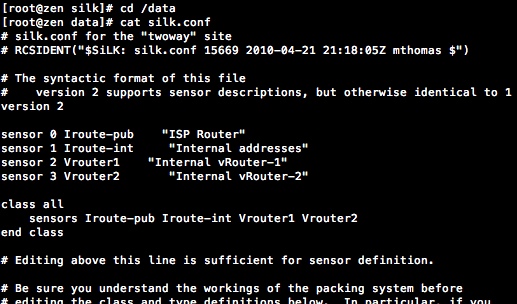
About netsa SiLK SiLK provides a way to capture netflow and interrogate flow data. It can be used for a variety of purposes including situational awareness, forensics and anomaly detection. Installing SiLK Prerequisites Before installing SiLK examine the perquisites for the build. I’m using CentOS 6.3 minimal install with a virtual machine disk of 100GB in total with a separate partition for /data of about 60GB. The virtual machine will be allocated 4GB of RAM and 2 virtual processors. Configure the network settings for your lab environment. In order to use YUM for installing software the the lab system will require access to the Internet. Download the following source code files from the netsa CERT project home page libfixbuf-1.2.0.tar.gz netsa-python-1.3.tar.gz silk-2.5.0.tar.gz yaf-2.3.2.tar.gz Copy the required packages to the /usr/local/src directory. If you are using scp to copy over the packages dont’ forget ‘yum install openssh-clients’ first on the serv...
The Collective Intelligence Framework or CIF for short provides a variety of security intelligence feeds that you can use in your environment. CIF requires a server to collect the information from a variety of sources and a client program that can be used to access the intelligence data. CIF has feeds for malware, botnets, suspicious IP addresses, and scanning IP addresses etc. Installing the CIF client on my SiLK server makes using CIF intelligence data with SiLK commands easy, simply follow the instructions for installing the client here . CIF has a number of ways you can output the intelligence data dependent on how you want to use it. For example the following command produces snort rules as output. The -p snort part causes the output of CIF to be in snort rule format but all that's required for use with SiLK is CSV format. One of the clever things that CIF does is to provide IP addresses for source data even when the source data does not provide IP addressing such as f...

Comments
Post a Comment